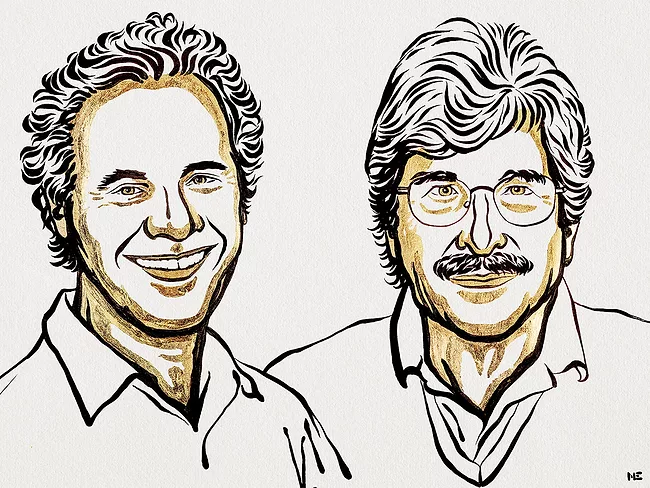
Bio Japan 2025 was abuzz with the news that Japan has once again snagged the Nobel Prize in Physiology or Medicine, with Shimon Sakaguchi winning for his discovery of a subtype of CD4-expressing T cells that affect the immune response. Earlier today, Susumu Kitagawa snatched the second Nobel Prize for Japan, this time in chemistry. Both Nobel Prize winners were professors at Kyoto University.
Bio Japan 2025 was abuzz with the news that Japan has once again snagged the Nobel Prize in Physiology or Medicine, with Shimon Sakaguchi winning for his discovery of a subtype of CD4-expressing T cells that affect the immune response. Earlier today, Susumu Kitagawa snatched the second Nobel Prize for Japan, this time in chemistry. Both Nobel Prize winners were professors at Kyoto University.
The 2025 Nobel Prize in Chemistry “is a story full of holes, but with enormous capacity to absorb all your attention,” Heiner Linke told reporters. “And other things.” Linke is Chair of the Nobel Committee for Chemistry. On Oct. 8, 2025, the committee announced that it has awarded the 2025 Nobel Prize in Chemistry to Susumu Kitagawa, Richard Robson and Omar Yaghi “for the development of metal-organic frameworks” (MOFs).
The Nobel Committee announced today that it has awarded the 2025 Nobel Prize in Physiology or Medicine to three scientists for their discovery of regulatory T cells, which are a critical part of the way the body prevents autoimmune attacks.
The Nobel Committee announced today that it has awarded the 2025 Nobel Prize in Physiology or Medicine to three scientists for their discovery of regulatory T cells, which are a critical part of the way the body prevents autoimmune attacks.
David Baker, Demis Hassabis and John Jumper share the 2024 Nobel Prize in Chemistry for their contributions to the science of protein structure. David Baker was awarded half the prize “for computational protein design,” according to the Royal Swedish Academy of Sciences. Hassabis and Jumper shared the other half “for protein structure prediction.”
It’s hard to know where to start in describing the biopharma applications of the 2024 Nobel Prize in Physics. It was awarded to John Hopfield and Geoffrey Hinton “for foundational discoveries and inventions that enable machine learning with artificial neural networks.”
David Baker, Demis Hassabis and John Jumper share the 2024 Nobel Prize in Chemistry for their contributions to the science of protein structure. David Baker was awarded half the prize “for computational protein design,” according to the Royal Swedish Academy of Sciences. Hassabis and Jumper shared the other half “for protein structure prediction.”
It’s hard to know where to start in describing the biopharma applications of the 2024 Nobel Prize in Physics. It was awarded to John Hopfield and Geoffrey Hinton “for foundational discoveries and inventions that enable machine learning with artificial neural networks.”
Research into the regulation of gene expression experienced a significant breakthrough with the discovery of microRNA, small RNA molecules that do not code for proteins but control their translation. This finding has earned its discoverers – Victor Ambros and Gary Ruvkun – the 2024 Nobel Prize in Physiology or Medicine “for the discovery of microRNA and its role in post-transcriptional gene regulation.”